2014年10月19日日曜日

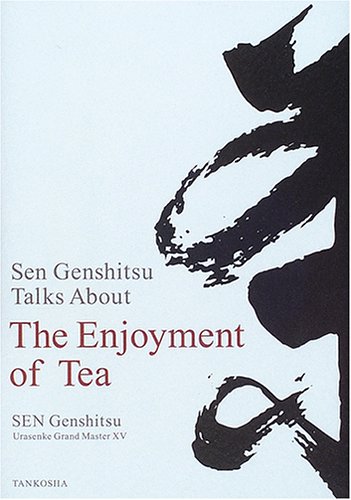
The Enjoyment of Tea

I read Sen Genshitsu Talks About The Enjoyment of Tea, written by Sen Genshitsu, and translated in English by Maya L. Perry.
The reason that I came to reading this book was an assignment of English class. I was searching some resources for my essay about tea ceremony, and I found this in the school library.

The author, Sen Genshitsu (1923-) is the former iemoto or head of the Urasenke school of Japanese tea ceremony. Urasenke is one of the main school of Japanese tea ceremony, which has been continuing for about 350 years. The history dates back to Sen no Rikyū (1522-1591), the Japanese historical person who perfected tea ceremony.

This book does not provide practical instruction, but rather deals with the spirit of tea with referring author's own experience.
For example, Sen Genshitshu remarks that transposition of guest and host occurs in a tea gathering. In other words, the guest becomes the host, and the host becomes the guest through tea.
The host never should think that "I'll show you" or "I'm doing this for you," but just think the guest and focus on doing one's utmost best to create a bowl of tea. Likewise, the guest should accept the invitation with all one's heart . That is transposition or consideration for each other. I was surprised to know that the author, the expert of tea too, rates himself after tea gatherings as; "My temae (performance) was only 65% today."

In another aspect, the author expresses his view as one who experienced warfare, through tea. With the hope that tea will provide peacefulness for people of the world, and Japanese spirit for the Japanese young generation, the author keeps spreading the spirit of tea.

The reason I chose this topic as the theme of the essay was partly because I belong to the tea ceremony club in the university. And next weekend, I will show my performance at the school festival.
I learnt many attitudes toward tea from this book, so  I want to practice these attitudes in every performance.

2014年9月3日水曜日

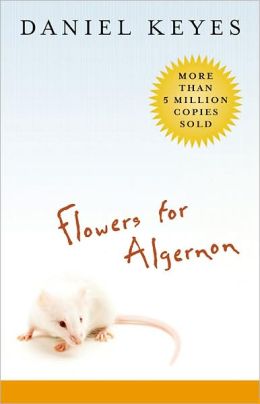
Flowers for Algernon

I read Flowers for Algernon, written by Daniel Keyes.
This is a story of a man who took a surgery that  improves his intelligence.
The man, Charlie Gordon was intellectually retarded by nature and took a brain surgery in order to improve his IQ. The title, Algernon is a mouse that took a same surgery as Charlie, and it takes an important role in the story.

This novel takes a style of Charlie's diary, and his intellectual change can be seen as dates passes. And as his intelligence increase, his emotional and moral aspects also change.
I once read this book in Japanese when I was junior high school student, but I didn't remember the most of the content, so I felt it fresh and impressive. I felt Charlie's mental conflict as a subject, and as a man. I wonder how difficult it is to control the human rights and to understand the difference between animal and human. And in this book, the last was especially impressing and made me think.

This novel was first published in 1959, but the oldness isn't felt at all, but rather it should be read in this era that scientific technology has greatly developed.
I also want to read The Minds of Billy Milligan, written by Daniel Keyes, later.
The summer vacation is almost over, and autumn term will start soon. I'd like to read some books during the term too.


2014年8月14日木曜日

Do Androids Dream of Electric Sheep?

I read Do Androids Dream of Electric Sheep?/BLADE RUNNER, written by Philip K. Dick.
This novel was first published as Do Android Dream of Electronic Sheep? in 1969, and filmed as BLADE RUNNER in 1982.
This is a science fiction novel about a bounty hunter lives in ruined earth, whose job is to kill (in the story, to retire) escaped androids from Mars.

I've known the title of it and had interest, so I borrowed the book from the library, but when I started reading this book, I found it very difficult at once.
The motive of choosing this book was just its title, so I haven't estimated how it is difficult to read SF in English. Though it was hard to catch the view of its world and keep reading, I managed to read through it. 

The outline of the story is quite simple, just retiring androids, but its concept and background are very complex. 
The setting is ruined earth where most human beings have emigrated to Mars. And where living things are highly valued, and a certain kind of empathy is needed to all people. 
In that world, a group of new-type androids, which never feel empathy, has escaped from Mars for the earth and the main character, Rick Deckard set to work.
There is no clear explanation about its background in the book, but instead characters' mind is described in detail throughout the novel, to animate the world view.
So it was hard for me to grasp the context at first, and I had to read through it twice to understand most of the content.
This book was difficult for me to read, but I could enjoy the atmosphere, and I want to read it again sometime.
I hope I will be able to appreciate English books someday.


2014年7月23日水曜日

The Alchemist

I read The Alchemist written by Paulo Coelho.
This is a story of a young shepherd who pursues his treasure.
One time a shepherd had an impressive dream of the pyramid, and a mysterious old man he encountered informed him that visiting Egypt and finding his treasure at there is his personal legend. And then, he started his journey to the pyramid.

This is not the kind of fantasy like slay a dragon or save the world, but rather familiar one to us.
I think the theme of this story is to accomplish one's dream. And in this story, the dream is expressed as personal legend.
Everyone has own personal legend in each heart, but few people try to realize them, a character said.  But once decide to realize it, every omen helps one who pursues one's personal legend, and every legend comes true, if one tries to, another character said.
This is a fantasy story, but I felt that the shepherd is one of us who keeps trying for one's dream.
The original version is written in Portuguese, but this novel is translated in many languages and read around the world. I think the reason is that this story reminds modern people to pursue what really want to do.


2014年7月6日日曜日

Girl with a Pearl Earring

I finished reading girl with a pearl earring written by Tracy Chevalier, which I chose as a summer reading.

This is a story about how Johannes Vermeer came to drew the painting of girl with a pearl earring.
This novel takes style of first-person narrative of Griet, the model of the painting.
The setting is 17th century Delft, Nederland. Sixteen-year-old Griet starts working at Vermeer's house as a maid for help her family, and become fascinated by his paintings and himself...

While reading this novel, I attracted by unique characters; Griet, another maid she works with, Vermeer, his wife, his mother-in-law, his children, a butcher's son, and Griet's own parents and siblings.
The basis of this story is romance between Griet and Vermeer, but circumstance around them and other characters make it more vivid.
And I think Chevalier's close historical research also gave reality to it. The values and customs are described well, and I could feel the atmosphere of that time.

But most of all, I admire Chevalier's great imagination. Though I'm not used to reading books in English, I could enjoy this book.
There is also a movie that based on this book, so I wanted to see it too.
Although I finished assignment already, I have plenty of time yet, so I want to read more English book during the summer vacation.


2014年6月23日月曜日

One more essay...

Though all classes done, I still have been busy because I have to write an essay for the music class and prepare for some tests.

I chose the Cantigas de Santa Maria as a theme of the music essay.
Cantiga means a monophonic song, written in Galcian Portuguese in middle age. And the Cantigas de Santa Maria is a collection of though cantigas, each includes the content that praises the Virgin Mary. It is one of the largest collections of non sacred songs from the medieval period, and it contains remarkable artworks and poetry too.

Why I chose this to the theme is that I listened one of cantigas in the class and became interested in it.
The music class I took in this term dealt with the western music history from ancient to Baroque period. Before I took this class, I have had little interest in music of that period, but I could understand its value and diversity through learning the history.
I'm glad to have such opportunity, and I will take the music class that deals with the history of after Baroque period in the next term, so I'm looking forward to it, too.

The essay is so burdensome, but I think what I learned in the ARW class is helping me a lot.
The deadline of it is tomorrow, so I have to make one more effort.

2014年6月16日月曜日

Precious two months

June 17th, the day after tomorrow is the last day of this term. And tomorrow, ARW class and some other classes will finish. 

I learned so many things during this two months, but I especially realized the importance of having own opinion.
We had many discussion and many opportunities to express each idea in classes.
I felt nervous in discussion at first because I've never had such opportunity in high school, but I realized that I can learn from others in discussions and other ways.
In ARW class and other ELA classes, I could learn many from classmates' opinions.
And in philosophy class too, we often had group discussion. I think that was great opportunity because I always had second or third year students in the group. So I often inspired by other group members' opinion. 

I regret that I could not make own remarks well, both in English and Japanese, but all opportunity was really great experience for me.
I want to be able to have own opinion, and contribute to others more.
For a start, I' d like to think every matter deeply.