2015年4月22日水曜日

Social Media and Japan

In the last RW class, we learned about Japanese situation of introduction of digital technology and social networking service into education and business.
I learned that Japanese current use of such devices is very poor, compared to Western country and some Asian countries. 

I think one of the reason is that SNS or digital devices are not so much familiar with the generation who governs university or companies. 
Most SNSs were deviced and developed in Western country and introduced into Japan, but I think such services like Facebook were uncomfortable with Japanese at that time, because Japanese people are sensitive to their privacy and tend to avoid exposing their information online. 
But these days, more and more people, especially the young generation, use SNS with their tablet devices or smart phones. Many university students have their Facebook account, Twitter account, etc. So I feel that potentially,Japanese universities and companies and whatever will use SNS or digital devices in their field in the near future, with alternation of generations. 
Though I don't think such future is necessarily good, sooner or later Japan will match up with other countries in the field of social media and digital devices.

2015年4月20日月曜日

The Danger of the Internet?

In the last class, we studied about the danger in using the Internet and digital tools, such as hacking or leaks of personal information, and learned some application softwares which can be possible solutions of such problem.

As I learned the potential risk factors of the Internet and digital tools, I felt some kind of foggy uncomfortableness. I think the Internet or devices like computer or smartphone were invented and have been progressed for making our life more convenient and comfortable in the first place, but I feel that modern people are exposed to more and more risks just by the Internet society.
We can apply more strong and stable protection for let security certain, but can't we do anything without using the power of the Internet or digital technology itself?
Had I become unable to do anything without using technology in this world?
I feel that the Internet gives me limitations unconsciously at the same time it gives me a lot of information and possibilities. 

2015年4月16日木曜日

April 15th's RW Class

In today's RW class, we covered some chrome and other browser's settings, information about online lectures such as ones given by the Open University and website like FutureLearn, and tips about Feedly and Blogger. 

 I have never thought seriously about taking online lectures, but I learned today that some courses are free, and I can apply for them by just enrolling online. I think the idea is fascinating, because I can take lecture I like at home, and some courses are given by special lecturers like prominent writers.
Though I am not sure whether I'll take those courses now because currently I am busy with my study at the university and some hobbies, I want to consider it if I could have time to spare.I am not a person like to be very progressive,  innovative or assert own theory on current issues, but I want to learn many things and opinions, and want to understand different views of others, so these stuffs will be very valuable for me.

2015年4月14日火曜日

Today's RW Class

Today, we started dealing with the corporation, written by Joel Bakan. Before start reading the content, we searched for 3B about the book. 3B is an abbreviation of Background, Biography and Bias. We looked for the content of the book, the author, the movie and the directors of the movie.

The author is a university professor of law in Canada, and we found that the content of the book is about the innovation of the cooperation today. Because modern corporations put emphasis on profit rather than individual happiness, the author argues that the cooperation should be changed as more liberal and people oriented institution. This also became a documentary movie in Canada with directors, Mark Achbar and Jennifer Abbott, who directed documentary movie of gay marriage. 
As we searched for information, we could find that the author is rather liberal, and approaches the issue from the point of law. I think that information will be very helpful in reading the book, and identify the author's position about the topic.   


2014年12月4日木曜日

Invisible Minority

The autumn term ended in November, and the winter term will start on this Friday.
So before new classes start, I'd like to look back what I learned and thought in last term.

In autumn, I took semiology class. We studied about sign and symbol, and those relation to linguistics. And as its assignment, I wrote a paper about "invisible minority."
In the class, we had several guest lecture, and one of those was dealing with oversymbolization of the Great East Japan Earthquake in 2011. The disaster caused massive damage, and a lot of the media brought up it with using symbols like "Fukushima" or "Tohoku." But the lecturer raised a question about that issue, because such overuse of symbols may cause stereotypes of its image, and overlooking the real problem among the victims, like mental issues.

Related to the lecture, I thought about the situation in minority groups. Forming groups and claiming for their rights might appeal their existence, but it may also cause a creation of another "invisible minority."
Sexual minority, for example, has come a long way to acquire a right in society. But as minority groups like homosexual people became visible, other people, such as bisexual or nonsexual people became invisible. Now the term, LGBT is widely accepted, but can this category include all minority people? Isn't it making fixed image, and preventing other people from recognizing different personality?
These term or image may facilitate general recognition, but I think this attitude will also facilitate stereotypes. As each person has different character in majority groups, minority people too, have different personality.
I believe that we should claim rights as a person, not as a group, and everyone should strive to recognize each personality.
But we can't help getting fixed image through media, like in the case of the disaster and minority groups, so I think direct communication is the only way to overcome them.
We should not just accept information, but learn it at first hand.

2014年10月19日日曜日

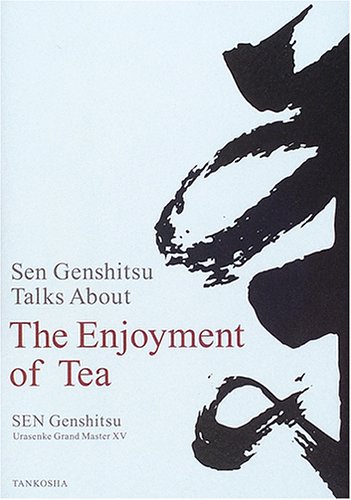
The Enjoyment of Tea

I read Sen Genshitsu Talks About The Enjoyment of Tea, written by Sen Genshitsu, and translated in English by Maya L. Perry.
The reason that I came to reading this book was an assignment of English class. I was searching some resources for my essay about tea ceremony, and I found this in the school library.

The author, Sen Genshitsu (1923-) is the former iemoto or head of the Urasenke school of Japanese tea ceremony. Urasenke is one of the main school of Japanese tea ceremony, which has been continuing for about 350 years. The history dates back to Sen no Rikyū (1522-1591), the Japanese historical person who perfected tea ceremony.

This book does not provide practical instruction, but rather deals with the spirit of tea with referring author's own experience.
For example, Sen Genshitshu remarks that transposition of guest and host occurs in a tea gathering. In other words, the guest becomes the host, and the host becomes the guest through tea.
The host never should think that "I'll show you" or "I'm doing this for you," but just think the guest and focus on doing one's utmost best to create a bowl of tea. Likewise, the guest should accept the invitation with all one's heart . That is transposition or consideration for each other. I was surprised to know that the author, the expert of tea too, rates himself after tea gatherings as; "My temae (performance) was only 65% today."

In another aspect, the author expresses his view as one who experienced warfare, through tea. With the hope that tea will provide peacefulness for people of the world, and Japanese spirit for the Japanese young generation, the author keeps spreading the spirit of tea.

The reason I chose this topic as the theme of the essay was partly because I belong to the tea ceremony club in the university. And next weekend, I will show my performance at the school festival.
I learnt many attitudes toward tea from this book, so  I want to practice these attitudes in every performance.


2014年9月3日水曜日

Flowers for Algernon

I read Flowers for Algernon, written by Daniel Keyes.
This is a story of a man who took a surgery that  improves his intelligence.
The man, Charlie Gordon was intellectually retarded by nature and took a brain surgery in order to improve his IQ. The title, Algernon is a mouse that took a same surgery as Charlie, and it takes an important role in the story.

This novel takes a style of Charlie's diary, and his intellectual change can be seen as dates passes. And as his intelligence increase, his emotional and moral aspects also change.
I once read this book in Japanese when I was junior high school student, but I didn't remember the most of the content, so I felt it fresh and impressive. I felt Charlie's mental conflict as a subject, and as a man. I wonder how difficult it is to control the human rights and to understand the difference between animal and human. And in this book, the last was especially impressing and made me think.

This novel was first published in 1959, but the oldness isn't felt at all, but rather it should be read in this era that scientific technology has greatly developed.
I also want to read The Minds of Billy Milligan, written by Daniel Keyes, later.
The summer vacation is almost over, and autumn term will start soon. I'd like to read some books during the term too.